I'm not one for New Year Resolutions. Every day of the year I resolve to 'do those things which I didn't do yesterday', 'try a little bit harder at that', and of course 'be a generally better person going forward...'. It's a constantly recurring theme in my life, and a major part of the strict Moral Code I endeavour to live by. The failure to achieve these resolutions on a regular and frequent basis is naturally cause for concern, but the trickle effect throughout the year helps to keeps me 'grounded' and 'generally hopeful' in a way that a big New Year Resolution failure probably wouldn't. I think I've said too much now, so on with the point of all this...
I've resolved to indulge myself more this year, mainly because a resolution as simple as this is relatively easy to achieve, and let's not forget that through indulgence lies happiness of a kind. For balance, I've also resolved to indulge Karen more this year too, which is of course entirely altruistic, and therefore carries none of the 'sinful baggage' of my first resolution. Clever eh! I've started early, spoiling Karen royally at Christmas with Chanel No.5, luxury Joules clothing, and Booja-Booja Chocolates. 'But what of yourself Mark?' I hear you ask... 'Don't forget your good self'' you cry. Well you'll be pleased to know I haven't.
Feast your eyes on these two beauties. Indulgence personified. I'm no stranger to the delights of Sampford Courtenay Cider. If nothing else, I'm a huge fan of their eminently re-usable swing-top bottles. The stuff inside is pretty good too, and by luck the Waitrose cider buyer seems to agree with me as this is where you'll find it. At the risk of becoming a full-on advert for Waitrose, have a look at this video, if only for a glimpse of the huge wooden 'Tuns' at Sampford Courtenay, which may or may not be in use but look fantastic nevertheless.
The seasonal offering is a Sloe & Elderberry Fruit Cider. The kind of mad concoction that could be little more than a sickly alco-pop in the wrong hands. The folk at Sampford Courtenay are a safe pair of hands where cider is concerned, and this is lovely, fruity, yet very grown-up stuff. The main point of interest for me is that it still has the tastes and aroma of cider. Rich, strong Devon cider, and really quite dry cider at that. Now it really shouldn't come as a surprise that a cider with other fruits added should actually taste of cider, but the fact is, most of these fruity concoctions seem to be made merely to disguise the cideriness, not enhance it. In the case of the bigger brands, it's all about making your cider as accessible to as wide a demographic as possible, and there's no better way of making your cider accessible than by making it taste like Ribena. We're absolutely not in Ribena territory here.
Did I mention it was Dry? Now that's a real surprise, not least because it's described on the Waitrose shelf as being Sweet. It's a full-bodied, chunky, dryish Devon Cider, carefully overlayed with a subtle berry sweetness, and a fair bit of mouth drying tannin which could originate from just about any of the primary ingredients. If you're looking for an easy-drinking alco-pop, look elsewhere, this is butch, grown-up stuff, at a grown-up price it must be said. If £4.99 a bottle seems a little pricey to you, just think of the lovely bottle you get free, and being a seasonal offering, hope as I do that a special offer is just around the corner.
Talking of special offers, there's really nothing more special (or indeed underhand) than offering a generous free tasting of something absolutely delicious on one of the last shopping days of Christmas. This is how I found myself in possession of a bottle of Zeni Acquavite di Williams, for which the people at Ben's Wine Shop in Oakham can be thanked, or indeed blamed. They obviously know a weak-willed man when they see one.
What can I say about this bottle? In a word, Lush. In four words, Really Very Lush Indeed. You can read the company blurb and details of this spirit here, keep scrolling past the grapey stuff, it's near the end. It's a smooth little devil for sure, spirity, but not at all firey, with a long-long, juicy Williams Pear finish. This takes me all the way back to skiing holidays in Austria, without the troublesome bother of trying to ski that is. It's a versatile spirit, good in a Hip Flask, equally at home straight from the fridge with a slice of Smoked Salmon. It's lovely, indulgent, and a great start to my year of immoderation.
Showing posts with label Pears. Show all posts
Friday, 6 January 2012
Sunday, 10 April 2011
Blakeney Red - The Sweetest Pear
![]() |
| Blossom on Pear Tree Middleton Village Orchard |
Friday was spent drinking some very good (and some not so good) ciders and perries in the metropoli' of Nottingham and Beeston, of which I'll write more at a later date. Saturday was just made for a spot of gardening. Sowing seeds, constructing Sweet Pea supports, mowing the tufty remnants of our hen-pecked lawn, and generally working up a good honest thirst. Three cheers then for Red Kite Cider. Three cheers too for a profusion of Pear Blossom and generally frost-free nights. Looks like it could be a good year for perry pears.
Sunday is strictly a day of rest in the Rockingham Forest Cider household. I spent most of the day 'resting' in the ciderhouse with a length of hose and several empty barrels, whilst Karen was 'resting' at Saddington Car Boot Sale, along with a boot-full of highly desirable junk. Not much of a rest then!
![]() |
| 'Polymeric Perry Pear Tannins' floating on top of this batch of Blakeney Red |
I'd earmarked this Sunday as the day for barreling up cider and perry for festivals at the Crown, Elton, and the Swan & Rushes, Leicester (see right). I've selected a lateish pressing of Yarlington Mill/Dabinett/unknown Sweet/Bramley, which has cleared nicely for a bittersweet blend, and weighs in at 7% abv. This will go out as a Medium version of our Rockingham Forest Cider.
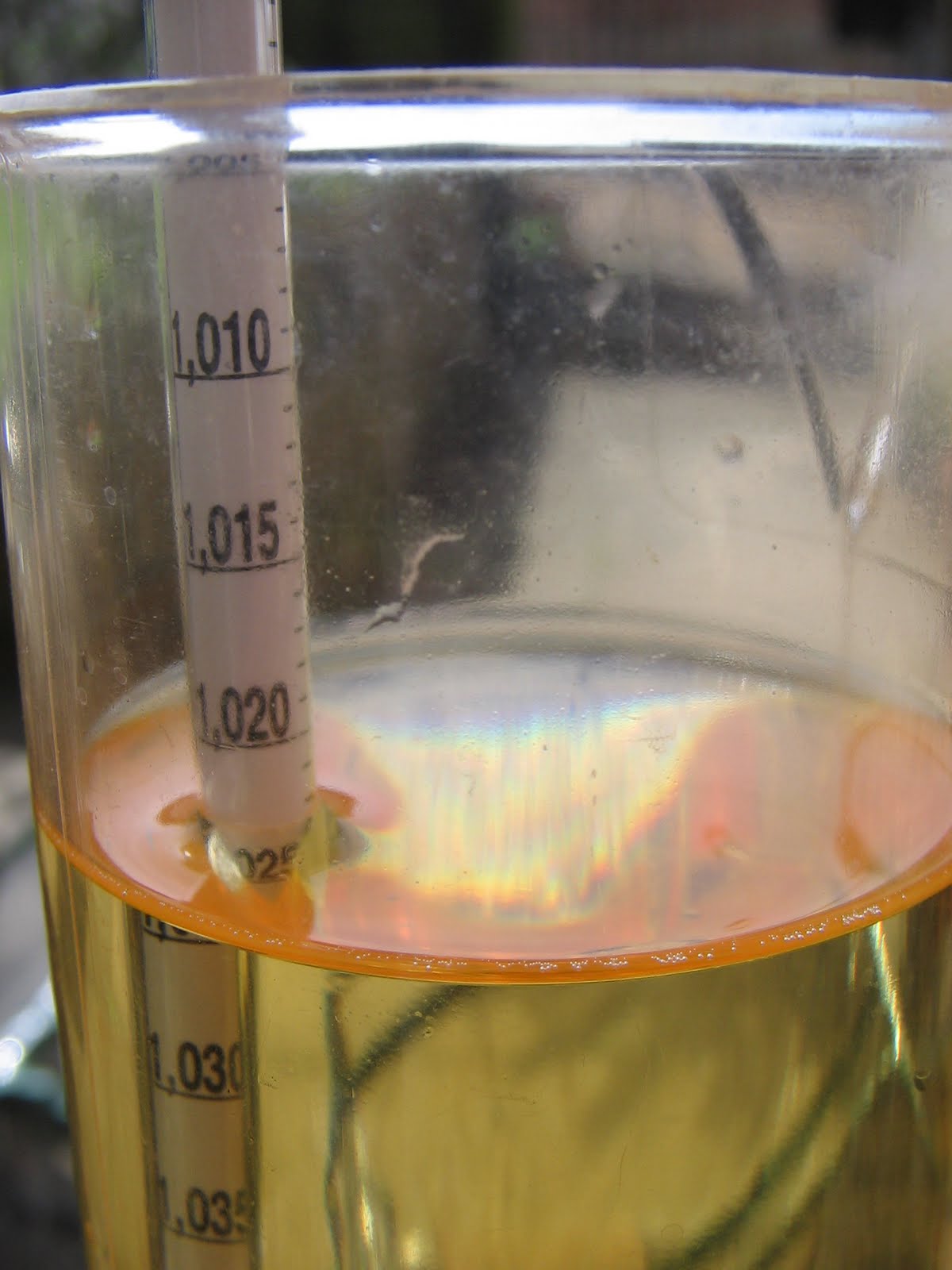
More intriguing is the perry I've chosen, a single variety, naturally sweet Blakeney Red. Most of our perries have finished quite sweet this year, although one or two are still fermenting away quite merrily. This one has finished with a very high gravity (1.023), giving a full-on sweet perry, not too tannic, and clear as a bell in the glass. It's lovely stuff, but thanks to the higher than normal gravity, it's unusually low in alcohol at around 4% abv. The holy-grail of cider and perry making is to produce a naturally sweet,
relatively low alcohol drink, so I shouldn't complain. Whilst it's well-known that many people prefer their cider and perry on the sweeter side, we've also noticed that some people (women in particular) can be quite put off by the high strength of the more traditional drink. A 4% perry is not something we would normally aim for, but it's certainly a very 'commercial' strength, and I think this perry will sell very well indeed, particularly if we're blessed with more of this lovely warm weather. Oh! sorry, I forgot it's a Bank Holiday. Never fear, it should go equally well with rain...
Labels:
Cider House,
Fermentation,
Festivals,
Pears,
Perry,
Pubs
Saturday, 16 October 2010
Ciderhouse News - Mid October
The weekend cidermaking started earlier than usual this week. On Thursday I collected the Kingston Black cider apples and Green Horse perry pears from Worcestershire, delivering them back to Rockingham Forest Cider HQ ready for pressing. The Kingston Blacks will be left to fully mature for a few weeks more before pressing, but the perry pears had already stood for a week following harvest, and were on the cusp of being overripe. We also pressed the apples and pears from Rockingham which will form this seasons Welland Valley Festival Special.
It was a long, hard day in the ciderhouse, but we were rewarded for our efforts with around 300 litres of cider and perry. The Green Horse pears have pressed with a similar sugar level to last years crop, giving a Specific Gravity of 1.050 (as measured with my shiny new German Hydrometer). This will produce a perry of around 6.4% abv, although only around 100 litres will actually be sold as a single variety perry. The rest will be used for blending with other perrys for our Rockingham Forest Perry.

The local Rockingham fruit had been left to mature slightly longer than absolutely necessary, resulting in a fair few apples and pears not making the grade due to rot. Not an ideal situation, but nevertheless I had high hopes for this fruit. There were four different varieties, all dessert fruit. An early, soft-fleshed apple with a lovely fragrance, though no great keeping quality; a crisp, sharpish eater, only just ripe at harvest; a probable Conference pear; and a
greenish/golden russeted apple, almost certainly Egremont Russet. The russets made up the bulk of the fruit, and I'm expecting a soft tannin from them to add a welcome complexity to the blend. All that waiting around will have helped the sugar levels, and I was pleased to record a Specific Gravity of 1.058, giving a potential abv of 7.4%.Once again we are relying on wild yeasts to get fermentation under way, and I'm pleased to say that after a worryingly slow start, it's all systems go with the Malvern Hills and Blakeney Red perrys. Phew! Fermentation is very slow in these perrys, possibly due to the extremely low nutrient levels in this very old, largely unmanaged orchard. Slow fermentation is considered a good thing for flavour, just so long as it remains slowly ticking over, and not stopped entirely. No sooner has one fermenter got fermenting, than the wait begins for another to get going. Green Horse is at the starting gate and ready for the off...
Labels:
Apples,
Cider House,
Cidermaking,
Fermentation,
Pears,
Perry Pears,
Welland Valley,
Yeast
Wednesday, 29 September 2010
Here Today, Gone Tomorrow
Thanks to a tip-off from a friend in the village, I've spent the last two evening picking dessert apples and pears in a nearby country house orchard. There are around four different varieties of apple, at least half of which are Russets of some description. There are also a few cooking apple trees bearing very large green apples (Lord Derby at a guess), but we won't be using these in the cider. The russets are a bonus since they are widely regarded as being excellent for cidermaking purposes. If I can keep a few specimens in good condition, I'll be taking examples of all the varieties to the forthcoming Brocks Hill Apple Day event (10th Oct) in the hope that the resident apple experts can identify them for me.
All in all we've got maybe a quarter of a ton of fruit to press. This will form the core of our 2011 Welland Valley Festival Special Cider, along with the fruit from various other trees dotted around the village which are a few weeks off ripening yet.My pleasure at spending time in this lovely old orchard was seriously tempered by the knowledge that it almost certainly won't be there next year. Sadly there are plans to build on the land, and the orchard will be grubbed up in due course. Such a shame.
Here are a few photos I took this evening. Unfortunately the light wasn't very good, and the heavy rain created a few problems too, but hopefully you'll get an idea of what we'll soon be missing...


Sunday, 25 April 2010
Buds & Blossom
Sunday, 9 August 2009
Feeling a bit 'Waspish'
It's rare for things to go entirely smoothly in the orchard, and this season is no exception. The warm, wet weather we're experiencing this Summer has increased the prevalence of Scab on the smaller than average Bramley Apple crop. This being the tallest tree in the orchard, there are also secondary incidences of scab on some of the cider apple trees nearby. A few spots of Scab on the cider fruit isn't too much of a problem, but the chances of getting any big sun-ripened cooking apples for Winter storage seem pretty slim this year.
The village orchard seems to be carrying a lighter crop of cooking apples this year, although the big pear tree has a reasonable crop. I'll be scouring the valley over the next few weeks to assess the fruit for the new season Welland Valley Special Cider which we'd like to make a lot more of if possible. So in general, it's looking like a modest year for apple crops, though a few good sunny days into the Autumn would at least help give 2009 more of a 'Vintage' quality.
Worst of all is the potential of our small grape harvest, which was looking slightly smaller than last year even before something started eating them! The Rockingham Forest Hens can usually be relied on to poke their beaks in where least wanted, but can't take the blame this year as they're fenced off from the grapes. The finger of blame was being pointed in the direction of the local Blackbird population, and I was all set to string up some netting, which is very effective in stopping bird damage, when the identity of the real culprits became clear.
Red wine grapes such as the Regent and Rondo varieties we grow, can sometimes be very susceptible to attack from Wasps, something we haven't experienced before due to the Wasp population taking a bit of a knock this last two Summers. As soon as the grapes start to colour up they become very attractive to a Wasp, and word of the sweet bounty soon gets round in Wasp-ville! I counted maybe a couple of dozen Wasps feasting around the vines
today, and I doubt we'll get enough grapes for even a gallon of wine. Is there an effective way of stopping Wasp damage to grapes I wonder? How much more precious our six bottles of Rockingham Forest Red 2008 now seem.
The village orchard seems to be carrying a lighter crop of cooking apples this year, although the big pear tree has a reasonable crop. I'll be scouring the valley over the next few weeks to assess the fruit for the new season Welland Valley Special Cider which we'd like to make a lot more of if possible. So in general, it's looking like a modest year for apple crops, though a few good sunny days into the Autumn would at least help give 2009 more of a 'Vintage' quality.
Worst of all is the potential of our small grape harvest, which was looking slightly smaller than last year even before something started eating them! The Rockingham Forest Hens can usually be relied on to poke their beaks in where least wanted, but can't take the blame this year as they're fenced off from the grapes. The finger of blame was being pointed in the direction of the local Blackbird population, and I was all set to string up some netting, which is very effective in stopping bird damage, when the identity of the real culprits became clear.
Red wine grapes such as the Regent and Rondo varieties we grow, can sometimes be very susceptible to attack from Wasps, something we haven't experienced before due to the Wasp population taking a bit of a knock this last two Summers. As soon as the grapes start to colour up they become very attractive to a Wasp, and word of the sweet bounty soon gets round in Wasp-ville! I counted maybe a couple of dozen Wasps feasting around the vines
today, and I doubt we'll get enough grapes for even a gallon of wine. Is there an effective way of stopping Wasp damage to grapes I wonder? How much more precious our six bottles of Rockingham Forest Red 2008 now seem.
Wednesday, 15 April 2009
Blossom Time
It's Spring Blossom Time again. My runny nose and itchy eyes were an early clue, but the village pear tree is the real giveaway.Cherry blossom has been out in the village for a few weeks now, and the recent warm weather has somewhat predictably triggered off my annual Spring bout of Hay fever. The assorted apple trees dotted throughout the village are still to unfurl their delicate pink petals, but the huge old pear tree is now in full blossom and quite a wonderful sight.
The quantity of blossom would tend to suggest a bumper harvest of fruit this year, particularly as the crop was so sparse last season, but there's still time for poor weather or a late frost to scupper the pollination. One other
possible problem is that the only other pear tree of any size in the village that I know of, was chopped down last year! I just hope there are sufficient alternatives tucked away in peoples gardens to provide the bees and other pollinators with a ready supply of pear tree pollen.
The quantity of blossom would tend to suggest a bumper harvest of fruit this year, particularly as the crop was so sparse last season, but there's still time for poor weather or a late frost to scupper the pollination. One other
possible problem is that the only other pear tree of any size in the village that I know of, was chopped down last year! I just hope there are sufficient alternatives tucked away in peoples gardens to provide the bees and other pollinators with a ready supply of pear tree pollen.An interesting development for this year's Spring blossom time is on Joan Morgan's excellent Fruit Forum. With the aid of subscribers to this useful forum, Joan is hoping to track the emergence of fruit tree blossom across the country. Do have a look on the website to see how progress is being charted, from the earliest southern blooms, to later fruity flowerings as Spring heads ever northwards.

Thursday, 9 April 2009
Springtime Spritz
Early April is a time of eager anticipation. The ciders are very nearly ready, Spring pear blossom is poised and ready to unfurl, and our apple trees are on the cusp of leafing-out.I had a bit of a tasting session in the ciderhouse today. I was particularly interested in the Rockingham Forest Cider, which matures later than the Sulgrave Orchard Cider we've been busily selling since March. The ciders are clearing nicely and are perhaps a little brighter than usual, but there's still a tiny bit of yeastiness which should fade over the coming weeks. To my taste buds, cider is never better than at this time of year, youthful and straight from the fermenter. It has a slight spritz from the gentle fermentation which often occurs in the Spring, and a lovely freshness which will fade as the cider matures and mellows throughout the year. You only really get to experience this zesty 'Cider Nouveau' in the ciderhouse, and I strongly recommend a visit to one of the many farms and producers which open for sales at this time of the year. I usually get my 'early season cider fix' straight from the cask at Mike Johnson's Ross-on-Wye Cider & Perry Co, but this year I can indulge myself a little closer to home.
Spring blossom time is nearly upon us, the huge pear tree in the village orchard will soon be covered in delicate white blossom. The cider apple trees will flower a few weeks later, but growth continues apace in the nursery. It looks as if we'll have a 100% success rate with the Dabinetts which we grafted earlier this year, and two of the three dessert apples are romping away and leafing-up. The Golden Harvey is the only non-starter, which is a shame as this was the one I most wanted to propagate. Still, seven out of eight isn't bad for a beginner!News on this year's local Welland Valley Beer Festival continues to trickle out. The poster for the event can be seen on the sidebar of this blog, with a link to the Talbot's website for the latest news. A late addition to the participating pubs is the Marquis of Exeter in the picturesque village of Lyddington. This brings the total for the festival to eight pubs, scattered throughout the Welland Valley and including our local 'Cider-tap' the Red Lion, Middleton. More news as it arrives.
Labels:
Cider House,
Fermentation,
Festivals,
Orchard,
Pears,
Pubs,
Training and Pruning,
Welland Valley
Friday, 6 February 2009
Cheap Fruit Trees - Good or Bad?
Each year one or two of the budget supermarkets (and until recently, Woolworths!) have seen this as a great opportunity to add a small range of very reasonably priced fruit trees to their range. These budget trees can often be the first step for many into the wide and wonderful world of fruit growing, and I've heard nothing but good reports about the quality and vigour of these fruity bargains. If money is tight (and when is it not these days), they represent great value for the prospective orchardist.
Having said all that, there are to my mind several very real problems with opting for budget fruit trees, and if you can possibly afford it I would always recommend going the extra mile and buying a tree from a specialist nursery instead. Here's why:
For me, perhaps the single biggest problem with buying a budget apple tree is that it limits you to a very small choice of varieties. This wouldn't be such a problem if the varieties on offer were a bit more interesting, but sadly they always seem to be the 'usual suspects'. The fruit from Bramley, Cox, Jonagold, Conference etc. is all readily available to buy from supermarkets and greengrocers, and thanks to cold storage technology, available almost all year round. So why would we want to grow one of these ultra-common varieties? Surley the whole point of growing your own fruit is the opportunity to try something totally different from the norm, perhaps a rare and interesting variety from the literally hundreds available through specialist nurseries. Something that will suit your own taste, and perhaps just as importantly, your own specific soil conditions, microclimate, and skills as a gardener. You may also want to grow a variety which was developed locally to you, providing a little Local Distinctiveness.It's also worth mentioning that the varieties used for these budget trees are often chosen on the basis of their familiarity to potential purchasers, and not neccesarily because they're the best varieties to grow in the average garden situation. Cox's Orange Pippin, probably our most widely recognised dessert apple, is often one of the varieties on offer, despite the fact that the beloved Cox is a very difficult apple to grow without the use of all manner of sprays and chemical additions. The Cox is prone to Mildew, Scab, Canker, and is absolutely not suitable for cold, wet conditions.
Another problem with these budget trees is the rootstock. Unless things have changed recently, I've never been able to identify the rootstock used for these trees, crucial if you want to know it's
eventual size when mature. I suspect that most of these trees are grown on the popular MM106 rootstock, a good all-round stock, but perhaps too vigorous for smaller gardens, and certainly not suitable for a pot grown tree.
On a more technical level, the age of these trees can sometimes be a problem. If you want to train your fruit tree in a particular way, it's always best to start with as young a tree as possible. A one year-old tree (Maiden Whip) is often recommended since you can train the tree exactly to the form you require. A budget tree may be 2 or even 3 years old, and the basic form of the tree may already be too well established to train correctly.
There's no doubt that given the choice between planting a budget fruit tree, and not planting a tree at all, I would always recommend a trip to your 'local' Aldi or Lidl. But an apple tree is something that should thrive in your garden for decades, providing tasty fruit, beautiful blossom, shade and shelter well beyond it's pay-back time. I believe it really is worth spending a little bit extra for a variety which will be just that little bit more special, and is sure to give you pleasure for many years to come.
There is a good listing of specialist nurseries on the ukcider Wiki, including many which supply cider apple varieties: Nurseries for Apple & Pear Trees
Thursday, 7 August 2008
Orchard Update
As I've travelled around the counties of Leicestershire, Northamptonshire, and Cambridgeshire as part of the day-job, the potential for a bumper harvest of apples can be seen almost everywhere. Apple trees are doing really well this year, even though this season follows a similarly good crop last year. At the moment, things are looking good for our
plans to make plenty of cider from local apples, though only time will tell if the quality is as high as the size of the crop.
I examined our own trees today and noticed that the cooking apple tree is carrying a larger crop than we had last year. On a less positive note I noticed that many more of the developing apples are affected by Scab, a fungal disease which thrives in the hot and humid conditions we're experiencing this year. From the cidermakers point of view, scab is more of a cosmetic problem, of more concern to commercial growers of dessert and culinary apples where the appearance of the fruit is all important. Unfortunately it also impacts seriously on the keeping qualities of
the fruit. We only use a small amount of the fruit from this tree in our ciders, most are destined for pies, crumbles, family and friends. We'll have to be careful to only put into storage the very best quality fruit, otherwise we could lose most of this year's crop to the dreaded Brown Rot.
The dessert apple tree I thinned earlier in the year has held its crop well, and many of the fruits are of a size where we may be able to get them identified at an Apple Day event. The second picture here is a very good example of what happens when you don't thin the fruits sufficiently. I can't believe I managed to miss
this huge cluster which will give much smaller apples than the thinned ones.
The rest of the orchard seems to have shrugged off the early infestation of green aphid, and achieved some measure of natural balance between pests and beneficial insects. The only 'fly' in the ointment has been the bronzing/browning of some leaves on a few of the trees, which may have been caused by Fruit Tree Red Spider Mite, of which I can find no sign, or possibly Potash deficiency. I've given all the cider apple trees a sprinkle of potash as a tonic (Dabinett are particularly prone to Potash deficiency), and I'm pleased to say that none of the trees have been seriously affected by this mysterious problem.
As an update on the pear situation, we visited the Bewicke Arms at Hallaton for a meal earlier in the week, and the impressive espalier pear tree growing up the side of the pub had barely a pear on it! Has anyone seen a pear tree with a decent crop this year?
plans to make plenty of cider from local apples, though only time will tell if the quality is as high as the size of the crop.I examined our own trees today and noticed that the cooking apple tree is carrying a larger crop than we had last year. On a less positive note I noticed that many more of the developing apples are affected by Scab, a fungal disease which thrives in the hot and humid conditions we're experiencing this year. From the cidermakers point of view, scab is more of a cosmetic problem, of more concern to commercial growers of dessert and culinary apples where the appearance of the fruit is all important. Unfortunately it also impacts seriously on the keeping qualities of
the fruit. We only use a small amount of the fruit from this tree in our ciders, most are destined for pies, crumbles, family and friends. We'll have to be careful to only put into storage the very best quality fruit, otherwise we could lose most of this year's crop to the dreaded Brown Rot.The dessert apple tree I thinned earlier in the year has held its crop well, and many of the fruits are of a size where we may be able to get them identified at an Apple Day event. The second picture here is a very good example of what happens when you don't thin the fruits sufficiently. I can't believe I managed to miss
this huge cluster which will give much smaller apples than the thinned ones.The rest of the orchard seems to have shrugged off the early infestation of green aphid, and achieved some measure of natural balance between pests and beneficial insects. The only 'fly' in the ointment has been the bronzing/browning of some leaves on a few of the trees, which may have been caused by Fruit Tree Red Spider Mite, of which I can find no sign, or possibly Potash deficiency. I've given all the cider apple trees a sprinkle of potash as a tonic (Dabinett are particularly prone to Potash deficiency), and I'm pleased to say that none of the trees have been seriously affected by this mysterious problem.
As an update on the pear situation, we visited the Bewicke Arms at Hallaton for a meal earlier in the week, and the impressive espalier pear tree growing up the side of the pub had barely a pear on it! Has anyone seen a pear tree with a decent crop this year?
Sunday, 30 September 2007
Apples & Pears
One of the big advantages of picking your own fruit for cidermaking is that you can afford to be choosy about the quality of the fruit, and also handpicked or gathered apples will usually be much cleaner than those obtained from commercial orchards. This is because most commercial cider apple growers shake the ripe fruit from the tree, then collect them using a mechanised harvester which sweeps them up from the orchard floor. Everything goes into the hopper, rotten fruit, leaves, grass, and even the occasional stone. Of course the big drawback of picking your own is the extra labour involved, but the time saved when cleaning and processing the fruit just about makes up for this extra effort. Besides, an hour or two spent in an old orchard on a bright September day, is infinitely preferable to the hard graft of washing mud and slugs off a trailer load of bruised or rotten apples.
Subscribe to:
Posts (Atom)