Showing posts with label Fermentation. Show all posts

Saturday, 26 November 2011

Ciderhouse News - November

That's it, our cidermaking is all over for another season. No more apples will darken our doorway, we've had our fill of the Mill, and early morning Pressing has become thoroughly depressing. We've ran out of room, we have no more fermenters. So no more! Here is the news:


The final batch of bittersweet Vilberie apples reached full maturity well ahead of turning rotten, which is always a bonus in cidermaking. They were surprisingly juicy, and have helped pushed our fermenter capacity to the limit. In fact over the limit, as there are still six sacks of apples left we've no room for which will now end up as pig food in nearby Keythorpe. So here's the final inventory of what seems like the longest cidermaking season yet:

Ciders

Home Orchard Blend (70 litres) 1.060
Dabinett/Harry Masters' Jersey/Yarlington Mill Blend (70 litres) 1.062
Yarlington Mill Blends (1340 litres) 1.057 - 1.062
Vilberie Blend (470 litres) 1.060 - 1.062

Perries

Malvern Hills (240 litres) 1.069 - 1.071
Blakeney Red (190 litres) 1.060
Green Horse/Oldfield/Blakeney Red Blend (120 litres) 1.065
Red Longdon (120 litres) 1.058
Unknown Perry Pears (120 litres) 1.066

In other news, I feel I must draw your attention to the latest edition of award-winning CAMRA publication, Nottingham Drinker. Always a good read, with a stronger than average focus on cider issues under the editorship of Hucknall cidermaker and CAMRA activist Ray Blockley. The latest edition has confirmation of all the winners in the recent East Midlands Cider of the Year Competition held at Nottingham Beer Festival. We came a commendable second to Torkard Cider who took the top spot, with Scropton Cider of Derbyshire third. We also rated very highly amongst the Nottinghamshire Constabulary...

The soon to be announced 2012 Cider Workshop Photographic Challenge will be announced... soon. More details will appear on the Cider Workshop webpage just as soon as it's been agreed that pressing for 2011 has finished. We've finished! Get on with it Jez...

Sunday, 10 April 2011

Blakeney Red - The Sweetest Pear

Blossom on Pear Tree
Middleton Village Orchard
Well that was one hot-hot weekend.

Friday was spent drinking some very good (and some not so good) ciders and perries in the metropoli' of Nottingham and Beeston, of which I'll write more at a later date. Saturday was just made for a spot of gardening. Sowing seeds, constructing Sweet Pea supports, mowing the tufty remnants of our hen-pecked lawn, and generally working up a good honest thirst. Three cheers then for Red Kite Cider. Three cheers too for a profusion of Pear Blossom and generally frost-free nights. Looks like it could be a good year for perry pears.

Sunday is strictly a day of rest in the Rockingham Forest Cider household. I spent most of the day 'resting' in the ciderhouse with a length of hose and several empty barrels, whilst Karen was 'resting' at Saddington Car Boot Sale, along with a boot-full of highly desirable junk. Not much of a rest then!

'Polymeric Perry Pear Tannins' floating
on top of this batch of Blakeney Red 
I'd earmarked this Sunday as the day for barreling up cider and perry for festivals at the Crown, Elton, and the Swan & Rushes, Leicester (see right). I've selected a lateish pressing of Yarlington Mill/Dabinett/unknown Sweet/Bramley, which has cleared nicely for a bittersweet blend, and weighs in at 7% abv. This will go out as a Medium version of our Rockingham Forest Cider.

More intriguing is the perry I've chosen, a single variety, naturally sweet Blakeney Red. Most of our perries have finished quite sweet this year, although one or two are still fermenting away quite merrily. This one has finished with a very high gravity (1.023), giving a full-on sweet perry, not too tannic, and clear as a bell in the glass. It's lovely stuff, but thanks to the higher than normal gravity, it's unusually low in alcohol at around 4% abv. The holy-grail of cider and perry making is to produce a naturally sweet, relatively low alcohol drink, so I shouldn't complain. Whilst it's well-known that many people prefer their cider and perry on the sweeter side, we've also noticed that some people (women in particular) can be quite put off by the high strength of the more traditional drink. A 4% perry is not something we would normally aim for, but it's certainly a very 'commercial' strength, and I think this perry will sell very well indeed, particularly if we're blessed with more of this lovely warm weather. Oh! sorry, I forgot it's a Bank Holiday. Never fear, it should go equally well with rain...

Friday, 21 January 2011

Wild Things!

A year ago today, I posted my tasting notes on our perrys ahead of their first racking. Today I've been in the ciderhouse, sipping, swirling and nosing my way through the fermenters, and what a difference a year makes.

Last year we went over (almost) exclusively to 'wild yeast fermentations', relying on the naturally occurring micro flora on the fruit and in the ciderhouse to initiate the fermentations, rather than the addition of a single strain cultured yeast as we've done previously. Cultured yeasts are preferred by many cidermakers for their tendency to produce rapid fermentations, even in very cold weather, and give predictable results. Wild yeast fermentations on the other hand can be slow to start, and may give unpredictable results. So why do we choose this more risky path?

The short answer is 'complexity'. If managed well, through a combination of good hygiene, and the careful use of Sulphites to control unwanted spoilage organisms, wild yeast fermentations will usually produce more complex ciders and perrys. This is because in the initial stages of fermentation, a range of yeasts will be present, all working slightly differently to each other, and therefore producing a slightly different flavour profile. Of perhaps equal importance is the speed of the fermentation. A cultured yeast will have been selected to do a specific job as efficiently as possible. Under ideal conditions, a cultured 'cider' yeast can ferment out the juice to bone-dry in a matter of weeks. These fast fermentations can often lead to the more subtle esters and aromatic components being 'blown-off' in the froth and fizz. Wild yeast fermentations are generally much slower, and can result in more of the flavour being retained.

Unfortunately, we had some difficulty getting the wild yeasts in our perrys to start fermenting last season, and in most cases we resorted to adding a cultured yeast. I'm happy to say that this seasons perrys were much better behaved, and after a couple of weeks anxious wait, they all started to gently ferment away without the need for our intervention. Then things got very cold! Fermentation all but stopped in the perrys, and even now, things are moving pretty slowly.

So, it's a different season, with different growing conditions, and a generally later harvest than we experienced in 2009. Plus, we've done things somewhat differently in the ciderhouse. It's perhaps no surprise then that things have turned out rather differently, which just goes to highlight the very seasonal, and 'vintage' nature of cidermaking.

Malvern Hills - There's a slight yeastiness on the nose, as you'd expect at this early stage, but this perry has almost completely cleared. It's still quite sweet, with a rich pear flavour, and moderate tannins. I suspect the tannin may be stronger than it appears, due to it being masked by the sweetness. It would be nice if we could retain just a little of this sweeteness in the finished perry. 

Blakeney Red - This has a also cleared beautifully, with a slightly deeper colour than the Malvern Hills. There's no yeastiness present, and this perry is clean enough to drink now. There's a candy-ish sweeteness, and a rich, tinned pear juice flavour. Light tannin and gentle acidity makes this an extremely well balanced perry. I'm very pleased with this, although I would hope it will ferment out a bit more yet.

Green Horse - Wow! This perry still needs a little more time, but the flavour even now is fantastic. It's a hazy, very pale perry, with Lemon, Ginger, and Pear, enhanced by a rich sweetness, and good balancing acidity. A slightly sweetened Green Horse was my favourite perry of last season, and I'm hoping that this will be even better by the time we come to sell it.

I also tried a couple of the ciders, but they really are far too young to assess properly. At the moment the Welland Valley Festival Special is cloudy and some way off being ready, but still shows great potential. It's rich and fruity, dryish, with soft tannins and a slight bitterness in the finish. Vat #22 is a mixed bittersweet cider, which tastes like alcoholic apple juice. Nice, but not nearly cidery enough for my taste.

The next job is to rack off the perrys, which I'll be doing just as soon as I've got some longer 'O's from the 'Fork Handles' shop...

Tuesday, 14 December 2010

...and they're off... at last!


Early days I know, but it's already becoming clear that the 2010 cidermaking season will be remembered by many cidermakers for its Apple Lollipops, Pomace Slushies and Torpid Fermentations.

Here at Rockingham Forest Cider, we managed to avoid the misery and potential frostbite of Pressing during the big freeze, but the recent cold spell has played havoc with the performance of our delicate Wild Yeasts. All the later pressings of Yarlington Mill, Dabinett etc. have been extremely reluctant to show signs of life in the chilly ciderhouse. On one memorable early morning, we recorded a garden temperature of -11C, and though it's unlikely to have been this cold in the ciderhouse, I'm guessing the temperature will have hovered either side of freezing for the last few weeks. It would take a pretty hardy microbe to rouse itself for fermentation in these conditions, and so it's hardly surprising that none of them did. Bad Yeasts!

This ongoing lack of fermentation is a worrying thing for a cidermaker, so it came as a bit of a relief when last weekend's lull in the freezing conditions helped kick-start the last few malingerers into life. I'm now pleased to announce that it's a lot noisier in the ciderhouse, with all 25 fermenters finally fizzing and glopping away like ....err... big fizzy gloppy things.

The imminent return of freezing conditions shouldn't be anything to worry about. Once a fermentation gets going, the process by which the yeasts convert sugar to alcohol (and CO2), also generates a little bit of heat, hopefully just enough to keep things ticking over. Even this little demijohn of Green Horse Perry (right) continued to ferment throughout the Nov/Dec freeze. Notice the strange 'alien' gloop floating on the top of this perry, a common occurrence with high tannin perrys, something to do with 'Polymeric Perry Tannins'... or something!

With everything now as it should be in the ciderhouse, it's high time we turned our attention to the serious business of Unbridled Christmas Pleasure. More of which later...

Friday, 19 November 2010

End of Term Report

The 2010 pressing has finally come to an end for us here at Rockingham Forest Cider. The final day went well, a little too well in fact, and we had to rummage around our old homebrew equipment to find enough fermenting capacity for the juice we pressed. In total we've pressed around three and a half tons of fruit, giving a little under 2500 litres of juice. This is what we've got:

Perrys
Malvern Hills (130 litres) 1.060
Blakeney Red (260 litres) 1.050
Green Horse (260 litres) 1.050
Unknown (70 litres) 1.064

Ciders
Welland Valley Festival Special Cider (200 litres) 1.058
Mixed Bittersweet/Sweet Alford/Sharps (130 litres) 1.059
Kingston Black (70 litres) 1.055
Kingston Black/Sweet Alford/Sharps (400 litres) 1.056
Yarlington Mill/Dabinett/Sweets/Sharps (840 litres) 1.055
Sweet Alford/Sharps (130 litres) 1.047

Most of the ciders and perrys are now gently fermenting away, with only those pressed over the last week or so showing no signs of life yet. The wild yeasts have been slow to get going this year, possibly due to the slightly later pressing time which has meant colder conditions. Meanwhile, it's time we put our feet up for a bit. We've been picking, panking, and pressing almost every spare day for two months now, and whilst we enjoy most aspects of the work, there comes a time when it's nice to just.... well... Stop!

Saturday, 16 October 2010

Ciderhouse News - Mid October

The weekend cidermaking started earlier than usual this week. On Thursday I collected the Kingston Black cider apples and Green Horse perry pears from Worcestershire, delivering them back to Rockingham Forest Cider HQ ready for pressing. The Kingston Blacks will be left to fully mature for a few weeks more before pressing, but the perry pears had already stood for a week following harvest, and were on the cusp of being overripe. We also pressed the apples and pears from Rockingham which will form this seasons Welland Valley Festival Special.

It was a long, hard day in the ciderhouse, but we were rewarded for our efforts with around 300 litres of cider and perry. The Green Horse pears have pressed with a similar sugar level to last years crop, giving a Specific Gravity of 1.050 (as measured with my shiny new German Hydrometer). This will produce a perry of around 6.4% abv, although only around 100 litres will actually be sold as a single variety perry. The rest will be used for blending with other perrys for our Rockingham Forest Perry.


The local Rockingham fruit had been left to mature slightly longer than absolutely necessary, resulting in a fair few apples and pears not making the grade due to rot. Not an ideal situation, but nevertheless I had high hopes for this fruit. There were four different varieties, all dessert fruit. An early, soft-fleshed apple with a lovely fragrance, though no great keeping quality; a crisp, sharpish eater, only just ripe at harvest; a probable Conference pear; and a greenish/golden russeted apple, almost certainly Egremont Russet. The russets made up the bulk of the fruit, and I'm expecting a soft tannin from them to add a welcome complexity to the blend. All that waiting around will have helped the sugar levels, and I was pleased to record a Specific Gravity of 1.058, giving a potential abv of 7.4%.

Once again we are relying on wild yeasts to get fermentation under way, and I'm pleased to say that after a worryingly slow start, it's all systems go with the Malvern Hills and Blakeney Red perrys. Phew! Fermentation is very slow in these perrys, possibly due to the extremely low nutrient levels in this very old, largely unmanaged orchard. Slow fermentation is considered a good thing for flavour, just so long as it remains slowly ticking over, and not stopped entirely. No sooner has one fermenter got fermenting, than the wait begins for another to get going. Green Horse is at the starting gate and ready for the off...

Wednesday, 22 September 2010

Reaching the Pears Others Can't Reach...

The new cidermaking season has started in much the same way as it did last season. 10 sacks of Malvern Hills Perry Pears, harvested at just the right level of ripeness, whisked home and pressed within 48 hours of being picked. This variety of perry pear has a tendency to rot within days of becoming properly ripe, and the fruit will often rot on the tree before falling. Speed is therefore of the essence lest we lose the whole lot to the compost heap.

The Malvern Hills crop was a little less impressive this year, requiring just a little more effort to harvest enough pears for a large fermenter of pressed juice. This meant bringing our all-new Mega-Panker* into use so as to reach those tricksy just-out-of-reach pears right at the top of the tree. These perry pear trees are huge specimens, believed to have been planted by the monks of Pershore Abbey around 250 years ago. It's particularly pleasing to be using fruit from trees which have such a long, largely unbroken history of usage. I'm sure the monks would be envious if only they knew.

Sugar levels are good, giving an Original Gravity of 1.060, which is around 7.5% potential alcohol. Not quite as good as last years monster sugar levels, but more than respectable all the same. This lower sugar level is not really surprising, the back-end of the Summer has hardly been one to write home about, and it remains to be seen whether this years more modest vintage is reflected across the rest of the harvest of cider apples and perry pears.

The juice has now been lightly sulphited, and we hope that a natural yeast fermentation will take hold within a week or two. That's two large fermenters of Malvern Hills Perry we'll have in the ciderhouse. One ready to start fermenting, whilst last years perry is now finally ready to barrel up for sale.

* The Mega-Panker is simply a fibreglass, sectional 'flag pole', of the sort seen frequently at festivals and outdoor shows. I had to remove a few feet of very thin pole at the tip before firmly taping a 'U' bend of copper piping to the top for hooking around branches. It's a little bit ungainly in use, but once it's up there I can happily shake fruit from trees of really quite enormous height. Of course shaking hard apples and pears from such a height brings its own risks, and as you can see in this short video, a hard hat is mandatory when in use.

Tuesday, 13 April 2010

Seeing Red

No, this isn't my reaction to Chancellor Darling's recent cider duty shenanigans. All I will say on this issue is this: If your expecting a bit of common sense from any of the other political parties following the forthcoming election, think again. Woolly-thinking seems to go with the territory when politicians start talking about the evils of alcohol....

Which brings me to real point of this post. The long anticipated bottling of our 2009 vintage Rockingham Forest Red Wine happened this weekend. Six lovely bottles the result, I only wish there were more. Despite a vintage which appeared to be much better than that of 2008, the wine has turned out lighter in body, and more like the flavour profile I'd expect from an English red. There's still plenty of Raspberry and Cherry, a fair bit of tannin, and a good balancing acidity, but a bit less oomph!


There are a couple of things which come to mind about this vintage. The colour is slightly less 'inky' purple than the 2008, possibly the result of leaving the wine on the grape skins for a slightly shorter time. This may be a factor in the wine being less 'heavy'. I also think the wine is a fair bit drier, and this could be the result of using a Champagne yeast rather than one better suited to red wine. Champagne yeasts are notorious in cidermaking circles for remorselessly fermenting a juice to bone dry, and this extra dryness may account for the lack of body. Perhaps there's more to this wine making lark than I'd thought!

As with the ciders and perrys, patience is the key with wine, and I won't be opening any of these bottles until Christmas at the very earliest. I'm excited by the idea that one day, when we've accumulated several different vintages of our 'Estate Wine', we'll be able to have a good old-fashioned Cheese 'n' Wine party, with a 'vertical tasting' of the various vintages.

Wednesday, 7 April 2010

Sapping it Up


Now there's a sight to gladden the heart of orchardists and cidermakers alike. Each of the four seasons is of great interest to the cidermaker, but it's perhaps Spring which is the most eagerly anticipated.

Buds are swelling in the orchard. Plump fruiting ones like those shown above, as well as the much slimmer 'growth' buds which will give us this seasons new wood. The sap is certainly starting to rise, but is this 'budding' activity a little later this year? Well, after consulting last years notes I'd say it is, perhaps by as much as three weeks. This mirrors the widely reported late arrival of Spring throughout the country. I'm really not sure what this may mean for fruit-set and eventual cropping this season. On the face of it, there's likely to be less chance of a late frost to damage the blossom, and there's also the possibility of greater insect activity during the all important pollination period. Bumper crops for 2010? Let's hope so...

Activity in the ciderhouse continues, with some of the ciders and perrys showing a gentle Spring fermentation following the long cold Winter. Blends containing a high proportion of Yarlington Mill cider apples are the most active. Higher initial sugar levels, and a slower 'wild yeast' fermentation mean these ciders are unlikely to be ready for sale until May or even June. We're lucky in that there's no great rush to start selling our ciders, but the Yarlington Mill blends will be at the core of this years Rockingham Forest Cider, so if things continue in this leisurely way, we may be forced to sell something a little bit different at the Northampton and Welland Valley festivals.

Meanwhile, the last few pints of early season Blakeney Red Perry are still available at the Red Lion, Middleton. We've been enjoying a drop or two of this lovely perry at home too. It's particularly nice as an accompaniment to time spent sunning ourselves in the orchard with the hens. Here's a pic taken a few seconds before 'Dolly' helped herself to a generous beak-full. Binge-drinking hens! Careful Dolly, I know a man with a tax to cure that!

Tuesday, 26 January 2010

First Taste II - The Ciders

We're in no great rush to start selling our ciders, which is just as well really as all the signs point to them maturing a fair bit later than previous years.

Several factors have slowed things down in the ciderhouse, chief of which is that we didn't start our cidermaking until well into October, which is several weeks later than the early season dessert apples we pressed in 2008. A minor difference maybe, but compounded by the significant change in temperature from warm and sunny September, through to the chill of November. Colder weather means a slower, steadier fermentation, generally considered a good thing for overall quality, but not so good if speedy results are required.

Another factor is that all of this seasons ciders contain a high percentage of tannic bittersweet cider apples. I've previously found that ciders made with a high proportion of cider apples tend to take longer to clear and mature than those made from dessert and culinary fruit. This year we have very little early 'Eastern-Counties' style cider to fill the gap until the 'West-Country' stuff is ready!

This season we're relying on the natural yeasts on the fruit to ferment all of our ciders. Whilst most cultured yeasts have been selected to ferment in the most efficient way possible, often measured in weeks rather than months, wild yeast ferments tend to be much slower, sometimes continuing right through to the warmer Spring months. It's quite possible that some of our later pressings may continue to ferment right through until early Summer, and therefore may not be properly mature and ready to drink until Autumn comes round again! Such is the unpredictability of cidermaking.

So, bearing all this in mind, here's an early-early tasting of this years very young ciders. I've named them after the highest proportion of apples in each batch, which usually constitutes around 60-80% of the blend:

Yarlington Mill - Pick of the bunch, though nowhere near ready. Tastes great. Rich, mellow tannins, some sweetness, lovely deep golden colour. Still very cloudy though (see pic). Promises to be our best cider yet when fully mature.

Bulmers Norman - Sharp and very fruity. Some tannin, slight peardrops. Still cloudy and definately one for blending.

Vilberie - Clean, balanced flavour, with some hard tannin. Light golden in colour and slightly cloudy. Sharper than the Yarlington Mill, should mature into a very drinkable cider.

Welland Valley Special (Dessert/Culinary) - Fresh, fruity and very well balanced. Slight peardrops. This has almost cleared and is tasting very good already, but should be even better by the time this years Welland Valley Beer Festival comes around.

Thursday, 21 January 2010

First Taste - The Perrys

It's been almost four months now since our first pressing of the season, a trailer load of Malvern Hills perry pears, at a peak of sugary ripeness despite being picked in September. Unlike the later pressings of cider fruit, fermentation was quite rapid owing to the warm Autumn weather, and had all but finished by the time things turned colder in November. For this reason, Malvern Hills Perry can often be one of the earliest perrys available in the season, and I've been lucky enough to try some fine examples as early as mid-March.

Of all the different ciders and perrys we've pressed this season, the Malvern Hills is the one I've been most looking forward to trying. It's a particular favourite of mine, usually very pale in colour, crystal clear, with an exceptionally clean, fruity flavour. Like most perrys, Malvern Hills has a light, fragrant quality, Elderflower-like aroma, and fresh, fruity flavour. When sampled straight from the vat, there will often be a pleasant prickle of dissolved CO2, which only serves to enhance the delicate flavour of this highly regarded perry. It can also be very strong! Our Malvern Hills perry has been toned down a little through topping up with a smaller quantity of Blakney Red pear juice. Even so, it's still likely to achieve an alcohol level of 8.0% or more, which is around the maximum permitted level for a drink taxed as perry.

It's the 'racking-off' that provides us with the first opportunity to taste the fruits of last years Autumn labour. 'Racking' is the process of carefully syphoning the young ciders and perrys off the old yeast deposit (sometimes known as the Lees) into fresh vats. This can help to clarify the drink, but it's main purpose is to reduce the chance of 'off flavours' developing as the old yeast deposit breaks down over time. It's also a great opportunity to assess the general quality of each batch, and it may also be desirable to do a bit of blending at this stage. Finding a vat which has cleared naturally and lost the 'yeastiness' of a young, immature cider, is a real bonus at this time of year.

I spent most of Sunday racking the ciders and perrys, an exhausting task even with the help of our efficient little pump. The ciders are, not surprisingly, still very cloudy, and some months away from full maturity. In fact some of the very late pressings such as the Vilberie, which wasn't processed until mid-November, are not even ready to be racked yet. The perrys are much further forward, and showing great promise.

Malvern Hills - Clear, clean tasting, and showing only a slight yeastiness. This perry is almost ready to drink, though far too tannic at the moment. Needs another few months to mellow and soften, but should be an exceptional perry when ready.

Blakeney Red - We have two vats of Blakeney, one being quite cloudy, and still showing signs of fermentation. The other vat has cleared nicely, and finished fermenting with some sweetness remaining. It's soft, light and very well balanced, but still showing a very slight yeastiness. Now we've racked this off, I'm confident this should be ready for the forthcoming Leicester CAMRA Beer Festival in March.

Green Horse - Young, somewhat hazy in appearance, but the mild tannins in this should make for a very drinkable perry in another few months.

Vat #25 (Unknown Perry Pear) - Pale and hazy like homemade Lemonade. It may stay this way or clear to near colourless. This is fully fermented and quite dry, with a harder, slightly bitter tannin. Needs more time.

Vat #2 (Unknown Perry Pear) - A real surprise this one. Still very tannic, and therefore not quite ready, but a lovely pale golden perry, crystal clear with a delicious juicy-fruits flavour. Sadly most of this perry has been used for topping up purposes, though a very small quantity has been set aside for bottling and giving away to the long list of people who helped us make it!
Next: The Ciders

Wednesday, 23 September 2009

It's Only Natural

This picture shows the first signs of yeast growth and fermentation on the surface of our recently pressed Moorcroft Perry Pear juice. Whilst it's only been five days since we pressed this batch of juice, it always seems much longer when you're waiting for the fermentation to get going.

Following pressing, we added a small dose of Sulphite to prevent spoilage organisms turning the precious juice into perry vinegar or worse. For the first time this season, we plan to ferment all our ciders and perrys without the addition of a single strain cultured yeast. Instead we're relying on the natural yeasts present in the fruit, and those which have built up through successive seasons on our cidermaking equipment. Although this can be slightly more risky, there are definite advantages to natural yeast fermentations.

The early part of a natural fermentation is with a range of low alcohol-tolerant yeasts which can give an added complexity to the finished cider/perry. When these yeasts have done their job, the fermentation is taken over by the more robust Saccharomyces strains of yeast which tend to build up in the ciderhouse and cidermaking equipment over successive years of milling and pressing.

In previous years, the fermentation resulting from the addition of a cultured yeast has been rather too quick for our liking, and usually continues until all the sugars have been converted to alcohol resulting in quite a dry cider/perry. Natural yeasts tend to ferment the juice more slowly over the course of several months, giving ciders and perrys with a better, often sweeter flavour, and with less tendency to produce 'off' flavours such as Hydrogen Sulphide. For us it's all about fine tuning and aiming to improve our ciders and perrys, something all small-scale producers should aim to do in our opinion.

Thursday, 9 April 2009

Springtime Spritz

Early April is a time of eager anticipation. The ciders are very nearly ready, Spring pear blossom is poised and ready to unfurl, and our apple trees are on the cusp of leafing-out.

I had a bit of a tasting session in the ciderhouse today. I was particularly interested in the Rockingham Forest Cider, which matures later than the Sulgrave Orchard Cider we've been busily selling since March. The ciders are clearing nicely and are perhaps a little brighter than usual, but there's still a tiny bit of yeastiness which should fade over the coming weeks. To my taste buds, cider is never better than at this time of year, youthful and straight from the fermenter. It has a slight spritz from the gentle fermentation which often occurs in the Spring, and a lovely freshness which will fade as the cider matures and mellows throughout the year. You only really get to experience this zesty 'Cider Nouveau' in the ciderhouse, and I strongly recommend a visit to one of the many farms and producers which open for sales at this time of the year. I usually get my 'early season cider fix' straight from the cask at Mike Johnson's Ross-on-Wye Cider & Perry Co, but this year I can indulge myself a little closer to home.

Spring blossom time is nearly upon us, the huge pear tree in the village orchard will soon be covered in delicate white blossom. The cider apple trees will flower a few weeks later, but growth continues apace in the nursery. It looks as if we'll have a 100% success rate with the Dabinetts which we grafted earlier this year, and two of the three dessert apples are romping away and leafing-up. The Golden Harvey is the only non-starter, which is a shame as this was the one I most wanted to propagate. Still, seven out of eight isn't bad for a beginner!

News on this year's local Welland Valley Beer Festival continues to trickle out. The poster for the event can be seen on the sidebar of this blog, with a link to the Talbot's website for the latest news. A late addition to the participating pubs is the Marquis of Exeter in the picturesque village of Lyddington. This brings the total for the festival to eight pubs, scattered throughout the Welland Valley and including our local 'Cider-tap' the Red Lion, Middleton. More news as it arrives.

Wednesday, 21 January 2009

More Pump Action

A welcome break in the recent freezing weather last weekend meant it was high time for another Racking-off & Topping-up session. By racking-off we aim to remove the young, slowly clearing cider, from the old yeast deposit which should by now have settled at the bottom of the fermenter. The cold conditions won't harm the cider, but this session of racking-off involved the transfer of over 1000 litres of cider, a process likely to take most of the day and therefore not a job to be undertaken in bone-chilling sub-zero temperatures.

The time had come to plumb our shiny new pump into couple of lengths of food-grade tubing, and get down to some serious suction in the ciderhouse. The pump performed very well, sucking up the cider without disturbing the sediment, and squirting it into the fresh tub at a (slightly worryingly) high rate. The Okoflow 3000 pump has a flow rating of 50 litres/minute, which I found to be pretty accurate. One of our 120 litre fermenters was taking no more than 2-3 minutes to transfer, the bulk of the time throughout the day was spent cleaning and sterilising the tubs ready for the next batch of cider to be racked-off. This is considerably quicker than syphoning using gravity alone, a 70 litre fermenter racked-off in this way was taking around 10 minutes last year, and I would have struggled to complete the job in a day without the use of the pump.

The one possible disadvantage of using a pump to rack-off the cider, is the vigour of the transfer. The cider is sucked into the pump chamber clear and relatively un-agitated, but emerges in the other tube fizzing with tiny bubbles. This is the dissolved CO2 being liberated from the cider by the spinning impeller of the pump, a bit like twizzling a straw in a fizzy drink. We aim to keep as much of this dissolved CO2 in the cider at this stage, it helps to protect the cider from oxidisation and the possibility of bacterial infection. But even so, the cider should still have enough dissolved CO2 to protect it, and the warmer months of Spring will inevitably lead to a period of gentle fermentation which will also help.

I'm not the only cidermaker with pumps and racking-off on his mind. The ukcider discussion forum, the essential online destination for anyone with an interest in cider or cidermaking, is currently host to a lively debate on the relative merits of a wide assortment pumps. Perhaps not the most exciting discussion you're likely to find on ukcider, but it could be worse. A discussion on the merits of cider on the ukpumps* forum anyone?

*I made up the ukpumps forum, though I wouldn't be at all surprised to find that one really does exist!

Saturday, 29 November 2008

Raw Quality

Today was a choice between watching the struggling England rugby union team play the mighty All Blacks in a cosy Uppingham pub, or a tedious racking off and blending session in the freezing cold cider house. On balance frostbite and boredom in the cider house seemed the most rewarding option...

The Rockingham Forest Cider which we pressed in October has almost finished it's initial fermentation. Most of the tubs are showing little or no sign of activity, and it's now time to top them up ready for the cold Winter months. I've been looking forward to this little job ever since we pressed the apples from John's beautiful old Cotswold orchard. I had a good idea that the apples we harvested were good cider varieties, it's not too difficult to recognise a bittersweet cider apple, they don't taste very nice, but it's only now that I can truly gauge their quality.

With the aid of the trusty Rockingham Forest Cider Chicken Baster, I sampled each of the fermenters before topping up with one of the sharper blends of cider. The flavour is obviously a little on the raw side, and still largely dominated by yeastiness, but even so the rich bittersweet character comes shining through. I'm really pleased with the quality at this stage which promises to be even better than last year's vintage. Two of the tubs are still quite lively and sweet, and if anything these slow-movers show the quality of the blend even better.

I may have missed the rugby, but I can sleep safe in the knowledge that all is well in the ciderhouse tonight.

Saturday, 15 November 2008

Tasting, Topping-up, and Blending

The steady glop of fermentation has eased-off a little in the ciderhouse, and it's time for a spot of topping up. Vigorous fermentation should produce enough CO2 to purge the cider of harmful levels of oxygen, and being heavier than air should form a protective 'blanket' of gas over the surface of the cider. The most common faults in traditional cider, oxidisation and vinegar taint, can only occur when the cider is exposed to oxygen, so it's when fermentation slows right down and less CO2 is being produced that it's essential the ciders are under airlock and topped right up to exclude air.

I decided to use this as an opportunity for a spot of tasting and blending, which in turn led to the first racking-off session of the season. I don't usually rack the ciders off the old yeast deposit (lees) until the new year, but the early dessert apple cider we made in September has just about finished fermenting and most of the sediment has now settled out, so I was keen to assess the different batches ready for blending.

Whilst pressing the eight different varieties of dessert apple which went into this cider, we tried to blend the fruit as we went. We were aiming for consistency across the separate fermenters, but the specific gravities, which ranged from a fairly feeble 1044 up to a more respectable 1051, gave a good indication of our lack of success in this respect. Interestingly the flavour reflected this quite accurately too, the higher gravity ciders were much fuller flavoured, and also a fair bit sharper than those with a lower gravity which tended more to a lighter fruitiness. It seemed sensible to blend these to give an average gravity of 1047-48, equivalent to an alcohol level of around 6.4% if fermented out to a dry cider.

I'm pleased to report that the perry, which was also topped up, has a very good, healthy aroma. So far, so good, the incantations appear to be working.

The picture has of course got nothing to do with the topping-up and blending, but gives a good indication of the current state of the village orchard. These fallen Bramleys made for a nice picture, though sadly they're too bruised to store well, and far too acidic for cidermaking, so the orchard floor is where they'll stay.

Monday, 3 November 2008

Slow Starter

There's always one isn't there! The Welland Valley Special is playing hard to get, dawdling behind the other happily fizzing fermenters and refusing to become cider. This will not do!

We pitched the yeast into this final batch of cider a week ago, and since then I've taken regular peeks under the lid in anticipation of the fermentation bursting into life. The initial signs of yeast activity seemed good, the tell-tale ring of tiny bubbles appeared within a couple of days, but since then it's all gone quiet. The nose is a good instrument to bring into play at this stage, any signs of yeastiness, or the sharp pain of a nose full of CO2 would give the game away. Even the unmistakably foul aroma of H2S (common in the early stages of fermentation) wouldn't neccesarily be unwelcome, but this particular tub has remained resolutely appley with no sign that it wants to turn cidery in any great hurry.

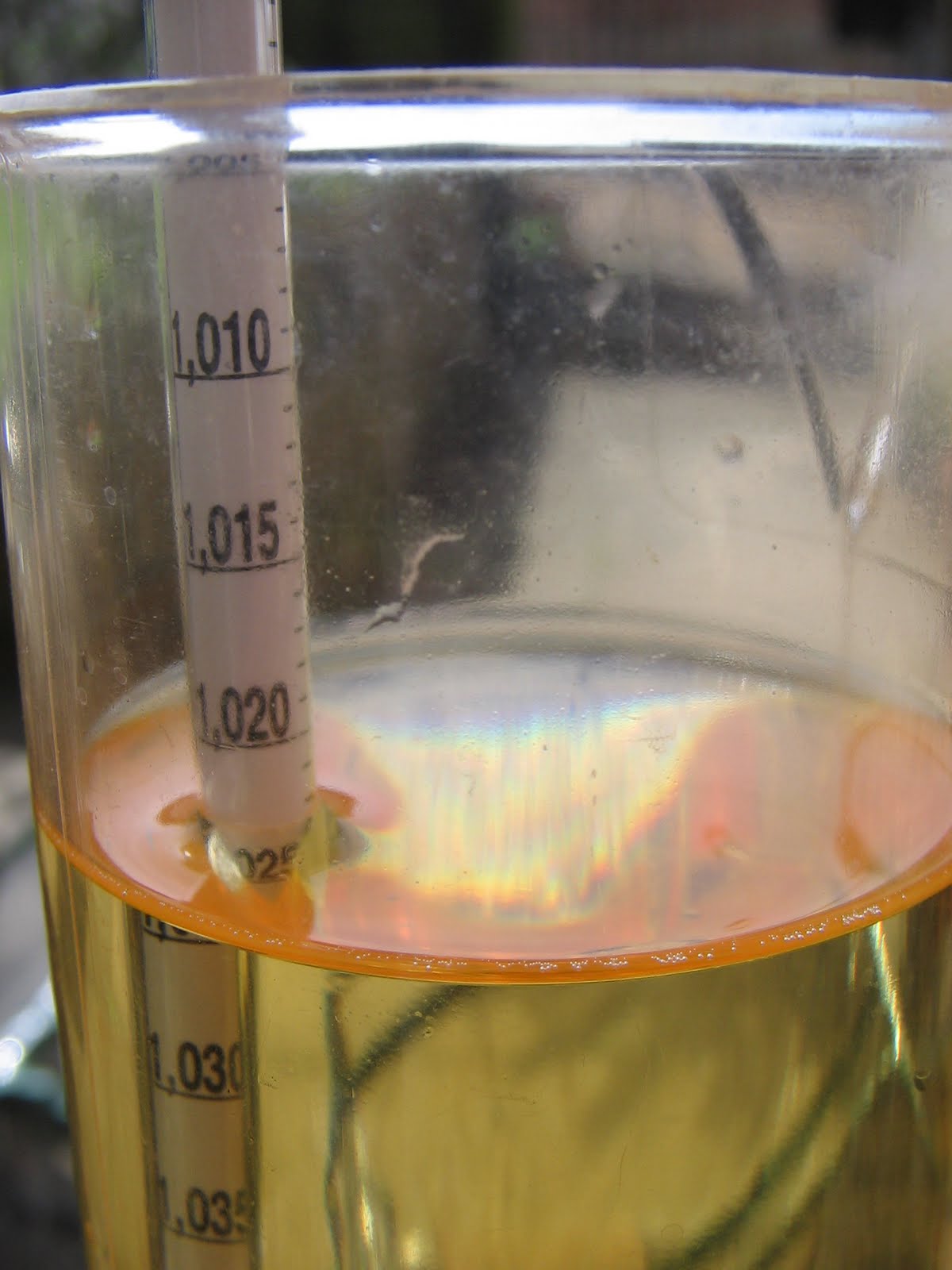
I confirmed the initial prognosis by checking the gravity with a hydrometer. It hasn't shifted from the initial 1047 of the freshly pressed juice. Oh well, no harm has come to it yet so I've pitched in a second dose of yeast and this will hopefully kick-start the fermentation. Back to peeking under the lid then...

Thursday, 2 October 2008

It's all kicking off...

This short, gloomy video is to help give you an idea of the activity in the ciderhouse at the moment. We added a cultured yeast to this batch of juice, and fermentation has been very quick to start. All 14 vessels are now glopping away merrily as the yeast converts the natural sugars in the apple juice into alcohol. Fermentation also produces a fair bit of heat, as well as a somewhat 'funky' aroma. We're leaving the garage door open whenever possible to help cool things down a little, but nothing much can be done about the diabolical sounds emanating from the busy airlocks. With our bedroom being directly above the ciderhouse, this constant noise will be lulling us to sleep for several weeks now.

Thursday, 24 April 2008

Quality Control

Yesterday I got down to the serious business of quality control. It's important to us that our regular outlets are happy with the product, and that it's selling reasonably well. This calls for regular visits throughout the year, often involving many hours of intensive sampling. Nice work if you can get it! The weather had taken a change for the better, and a stroll down the Welland Valley to the Hatton Arms in Gretton seemed like an excellent idea. The stroll ended up being a bit of a hike, for which my winter-weight body was slightly under prepared, but this is fine walking country, and it was well worth the effort.

The cider we delivered to the Hatton is selling well, and it's tasting pretty good too even though this is an early batch not quite at it's best yet. The good news is that our cider will only improve from here on in, and if we get a few more days like this one, the sales curve can only go upwards. The picture above shows the view from the smart decking at the rear of the pub. Though a little hazy, the picturesque village of Lyddington can be seen across the valley.

Back home the brilliant white pear blossom has now emerged, and right on time some of the ciders have started a secondary 'Spring' fermentation. I've had to pop airlocks back on one or two as the fermentation is quite vigorous. In olden days, before the role of yeasts in fermentation was widely understood, it was thought this spring activity was somehow associated with the arrival of the blossom itself. We now know that it's simply the warmer weather sparking the yeast into life again, or more rarely the presence of a Malo-lactic 'fermentation'. This isn't a fermentation at all, but a benign bacterial process which converts the Malic Acid in a cider into the less sharp-tasting Lactic Acid. Our ciders are not too sharp anyway, but the Malo-Lactic process is desirable because it can also produce additional complex flavours in the cider. Either way, activity at this time of the year is common and certainly not undesirable, though if the storage vessels have been sealed down tightly, it can lead to alarming bulges and maybe even explosions in the ciderhouse!

Monday, 18 February 2008

The Role of the Chicken Baster in Cidermaking

Things have gone very quiet in the ciderhouse. Fermentation has finished in all but a couple of vats, and it's now just a waiting game until the cider is ready to drink/sell. At this stage, during the really cold Winter days, I like to remove the airlocks and replace them with something more solid. This gives me the ideal opportunity to see how things have developed since the racking off in January.

A Chicken Baster is the ideal tool for this task. A suck and a squirt into a waiting sample glass is all it takes, before the fermenter is screwed down and sealed. I sampled from half the fermenters, and was very pleased to find that the ciders range from good to very nearly excellent, even at this early stage. The Welland Valley Cider, which was the earliest cider we pressed, is ridiculously 'Appley' and probably ready to drink now, which is a shame as this is destined for the Welland Valley Beer Festival in June. The other fermenters are still a little young, and will certainly improve over the next few weeks, but even these are clear, fruity, and eminently drinkable. Fermentation was a little quicker this season, and the ciders seem to be more advanced than previous years, so we may be able to start supplying our cider to our regular outlets a little sooner than we thought. Keep an eye on this Blog for news.